Kadushy Posts
Kadushy
Douchebag


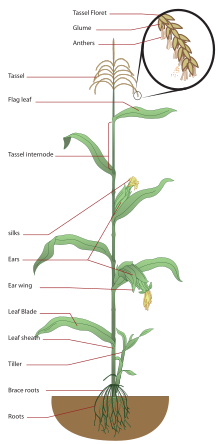
Maize ( /ˈmeɪz/ mayz; Zea mays L, from Spanish: maÃz after TaÃno mahiz) known in many English-speaking countries as corn or mielie/mealie, is a grain domesticated by indigenous peoples in Mesoamerica in prehistoric times. The leafy stalk produces ears which contain seeds called kernels. Though technically a grain, maize kernels are used in cooking as a vegetable or starch. The Olmec and Mayans cultivated it in numerous varieties throughout central and southern Mexico, cooked, ground or processed through nixtamalization. Beginning about 2500 BCE, the crop spread through much of the Americas.[1] The region developed a trade network based on surplus and varieties of maize crops. After European contact with the Americas in the late 15th and early 16th centuries, explorers and traders carried maize back to Europe and introduced it to other countries. Maize spread to the rest of the world due to its ability to grow in diverse climates. Sugar-rich varieties called sweet corn are usually grown for human consumption, while field corn varieties are used for animal feed and as chemical feedstocks.
Maize is the most widely grown grain crop in the Americas,[2] with 332 million metric tons grown annually in the United States alone. Approximately 40% of the crop — 130 million tons — is used for corn ethanol.[3] Transgenic maize (genetically modified corn) made up 85% of the maize planted in the United States in 2009.[4] While some natural strains of maize grow to 12 metres (39 ft) tall,[5] most commercially grown maize has been bred for a standardized height of 2.5 metres (8.2 ft). Sweet corn is usually shorter than field corn varieties.
Maize is the most widely grown grain crop in the Americas,[2] with 332 million metric tons grown annually in the United States alone. Approximately 40% of the crop — 130 million tons — is used for corn ethanol.[3] Transgenic maize (genetically modified corn) made up 85% of the maize planted in the United States in 2009.[4] While some natural strains of maize grow to 12 metres (39 ft) tall,[5] most commercially grown maize has been bred for a standardized height of 2.5 metres (8.2 ft). Sweet corn is usually shorter than field corn varieties.
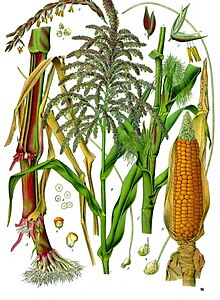
The word "maize" derives from the Spanish form of the indigenous TaÃno word for the plant, maiz.[6] It is known by other names around the world.
"Corn" outside the United States means any cereal crop, its meaning understood to vary geographically to refer to the local staple. In the United States, "corn" primarily means maize; this usage started as a shortening of "Indian corn".[7] "Indian corn" primarily means maize (the staple grain of indigenous Americans), but can refer more specifically to multicolored "flint corn" used for decoration.[8]
Outside the U.S., the word "corn" often refers to maize in culinary contexts. The narrower meaning is usually indicated by some additional word, as in "sweet corn", "corn on the cob", "popcorn", "corn flakes", "baby corn".
In Southern Africa, maize is commonly called "mielie" or "mealie"[9].
"Maize" is preferred in formal and scientific usage because it refers specifically to this one grain, unlike "corn", which has a complex variety of meanings that vary by context and geographic region. However, in bulk-trading, people use "corn" only to refer to maize.[citation needed] "Maize" is used by agricultural bodies and research institutes such as the FAO and CSIRO. National agricultural and industry associations often include the word "maize" in their name even in English-speaking countries where the local, informal word is something other than "maize"; for example, the Maize Association of Australia, the Indian Maize Development Association, the Kenya Maize Consortium and Maize Breeders Network, the National Maize Association of Nigeria, the Zimbabwe Seed Maize Association.


Many forms of maize are used for food, sometimes classified as various subspecies related to the amount of starch each has:
Flour corn — Zea mays var. amylacea
Popcorn — Zea mays var. everta
Dent corn — Zea mays var. indentata
Flint corn — Zea mays var. indurata
Sweet corn — Zea mays var. saccharata and Zea mays var. rugosa
Waxy corn — Zea mays var. ceratina
Amylomaize — Zea mays
Pod corn — Zea mays var. tunicata Larrañaga ex A. St. Hil.
Striped maize — Zea mays var. japonica
This system has been replaced (though not entirely displaced) over the last 60 years by multivariable classifications based on ever more data. Agronomic data were supplemented by botanical traits for a robust initial classification, then genetic, cytological, protein and DNA evidence was added. Now, the categories are forms (little used), races, racial complexes, and recently branches.
Maize has 10 chromosomes (n=10). The combined length of the chromosomes is 1500 cM. Some of the maize chromosomes have what are known as "chromosomal knobs": highly repetitive heterochromatic domains that stain darkly. Individual knobs are polymorphic among strains of both maize and teosinte.
Barbara McClintock used these knob markers to validate her transposon theory of "jumping genes", for which she won the 1983 Nobel Prize in Physiology or Medicine. Maize is still an important model organism for genetics and developmental biology today.[18]
The Maize Genetics Cooperation Stock Center, funded by the USDA Agricultural Research Service and located in the Department of Crop Sciences at the University of Illinois at Urbana-Champaign, is a stock center of maize mutants. The total collection has nearly 80,000 samples. The bulk of the collection consists of several hundred named genes, plus additional gene combinations and other heritable variants. There are about 1000 chromosomal aberrations (e.g., translocations and inversions) and stocks with abnormal chromosome numbers (e.g., tetraploids). Genetic data describing the maize mutant stocks as well as myriad other data about maize genetics can be accessed at MaizeGDB, the Maize Genetics and Genomics Database.[19]
In 2005, the U.S. National Science Foundation (NSF), Department of Agriculture (USDA) and the Department of Energy (DOE) formed a consortium to sequence the B73 maize genome. The resulting DNA sequence data was deposited immediately into GenBank, a public repository for genome-sequence data. Sequences and genome annotations have also been made available throughout the project's lifetime at the project's official site, MaizeSequence.org.
Primary sequencing of the maize genome was completed in 2008.[20] On November 20, 2009, the consortium published results of its sequencing effort in Science.[21] The genome, 85% of which is composed of transposons, was found to contain 32,540 genes (By comparison, the human genome contains about 2.9 billion bases and 26,000 genes). Much of the maize genome has been duplicated and reshuffled by helitrons a group of rolling circle transposons.[22]

Kadushy
Douchebag
http://www.ups.com/tracking/tracking.html
Kadushy
Douchebag

Kadushy
Douchebag
What.
Kadushy
Douchebag
My car got a buff job.
Kadushy
Douchebag
Fuck my ass off?
Kadushy
Douchebag
Saya <3
Kadushy
Douchebag
liger0 wrote...
So who else is going to pick up Lollipop Chainsaw tomorrow? If things work out, I'll be picking up the copy I pre-ordered over a month ago. I know already I'm gonna be hooked on this game for the next several days, if not the next week or two.I'm having it delivered to my doorstep by tomorrow since I pre-ordered it from Amazon when it was still $45, and choose same day delivery. It really does arrive on the same day too.
Annnnnnnd I'm not home tomorrow... so hmm..
Kadushy
Douchebag
You can always play it on a PS2 emulator.
Kadushy
Douchebag
Wow.. I had a conversation involving bath salt today... like 4 hours ago.
Kadushy
Douchebag
Me wants.
Kadushy
Douchebag
FFX <3 <3 <3 <3 <3
INSTABUY
INSTABUY
Kadushy
Douchebag
Zak, is that you?
Good luck. Prepare your anus when you come back.
Good luck. Prepare your anus when you come back.
Kadushy
Douchebag
devsonfire wrote...
Can I play? Can I play? Can I play? Can I play? Can I play? Can I play? Can I play? Can I play? Can I play? Can I play?Why yes you can, good sir.
Kadushy
Douchebag
Bye.
Kadushy
Douchebag
cruz737 wrote...
Why do people take OP seriously?Are you all that retarded?
yes
Kadushy
Douchebag
About once a month. Sometimes twice.
Kadushy
Douchebag
Wow... just wow.
Kadushy
Douchebag
winter55 wrote...
for kadushy
<3<3<3<3<3<3<3<3<3<3<3<3<3<3<3<3<3<3
Kadushy
Douchebag

Yes.
