Peltor Posts
Loner wrote...
Sindalf wrote...
Loner wrote...
Psssst, [size=7]the sequel is out[/h].Except Oblivion is better even without mods. With mods Oblivion is pretty awesome.
Unfortunately, I never got the chance to play it. Skyrim is my first Elder Scrolls game.
I've been playing since Morrowind, They've improved on a lot of things, Like removing a lot of the empty space that i found Oblivion was plagued with. Oblivion still has a special place in my heart, since i threw god knows how many hours into that game. But after playing Skyrim i don't think i'd be able to play the old Elder Scrolls games again.
That's just my opinion though, there's plenty of people who'd disagree with me. Which is fine, i can see why someone might enjoy oblivion over Skyrim.
Loner wrote...
IvIajoi2n wrote...
Put into a form that may be easier for some to understand.

Oh fuck you saved that shit, lol

Kaimax wrote...
Already doing it. :PKaimax is a Pioneer of Technology.
Before Apple was even founded, he was already using an Alienware. True story.


Thought i'd throw this up here, neat video.
Anyhow, Return to your usual IB banter, and as always feel free to derail.
alright, gotta get back to my HW now. k bye
Anyhow, Return to your usual IB banter, and as always feel free to derail.
alright, gotta get back to my HW now. k bye
Probably why the 3 new star wars movies didn't have the same nitty gritty sci-fi look. Since he only worked on the original 3
Rest in peace, one of the pillars and fore fathers of modern Conceptual Art.
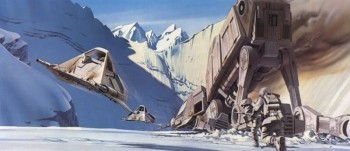
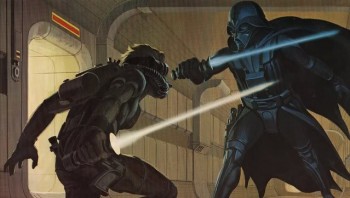
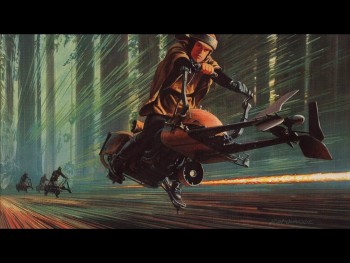
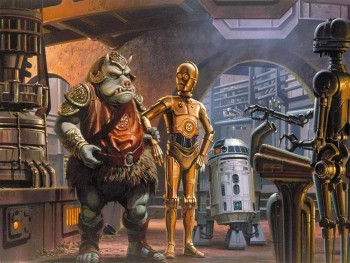
Ralph Angus McQuarrie (June 13, 1929 – March 3, 2012) was an American conceptual designer and illustrator who designed the original Star Wars trilogy, the original Battlestar Galactica TV series, E.T. the Extra-Terrestrial and Cocoon, for which he won an Academy Award.
Impressed with his work, director George Lucas met with him to discuss his plans for a space-fantasy film. Several years later, in 1975, Lucas commissioned McQuarrie to illustrate several scenes from the script of the film, Star Wars. McQuarrie designed many of the film's characters, including Darth Vader, Chewbacca, R2-D2 and C-3PO[4][5] and drew many concepts for the film's sets.[2] It was McQuarrie who suggested that Vader wear breathing apparatus.[1] McQuarrie's concept paintings, including such scenes as R2-D2 and C-3PO arriving on Tatooine, helped convince 20th Century Fox to fund Star Wars, which became a huge success upon release in 1977.[2][3][1][6] Neil Kendricks of The San Diego Union-Tribune stated McQuarrie "holds a unique position when it comes to defining much of the look of the "Star Wars" universe."[3] McQuarrie noted, "I thought I had the best job that an artist ever had on a film, and I had never worked on a feature film before. [...] I still get fan mail — people wondering if I worked on Episode I or just wanting to have my autograph."[3]
McQuarrie went on to work as the conceptual designer on the film's two sequels The Empire Strikes Back (1980) and Return of the Jedi (1983).[3]
Christian Blauvelt of Entertainment Weekly praised McQuarrie's works as "pioneering of the 'used future' aesthetic" which unlike other science-fiction, "imagined a lived-in galaxy that was gritty, dirty, and in advance states of decay." He described McQuarrie's style as "strongly geometric subjects rendered in muted colors against a flat, purposefully compressed backdrop. A McQuarrie Star Wars design looks like what would have resulted if Salvador Dali had sketched concepts for Universals 1936 Flash Gordon serial by way of Sergio Leones Old West."[7]
McQuarrie played the uncredited role of General Pharl McQuarrie in The Empire Strikes Back. He appears in Echo Base on Hoth in the film's opening sequence.[1] An action figure in his likeness as "General McQuarrie" was produced for Star Wars 30th anniversary.[5][1] Action figures based on McQuarrie's concept art, including conceptual versions of the Imperial Stormtrooper, Chewbacca, R2-D2 and C-3PO, Darth Vader, Han Solo, Boba Fett, Obi-Wan Kenobi, Yoda and other characters have also been made.[8]
McQuarrie designed the alien ships in Steven Spielberg's films Close Encounters of the Third Kind (1977) and E.T. the Extra-Terrestrial (1982),[3] while his work as the conceptual artist on the 1985 film Cocoon earned him the Academy Award for Visual Effects.[9][5] He also worked on the 1978 TV series Battlestar Galactica,[5] and the films Raiders of the Lost Ark, Star Trek IV: The Voyage Home, *batteries not included and Jurassic Park.[6]
[edit]Retirement and death
Rick McCallum offered McQuarrie a role as designer for the Star Wars prequel trilogy, but he rejected the offer, noting he had "run out of steam" and Industrial Light & Magic animator Doug Chiang was appointed instead. McQuarrie retired and his Star Wars concept paintings were subsequently displayed in art exhibitions, including the 1999 Star Wars: The Magic of Myth.[3] Several of McQuarrie's unused designs from the original trilogy were utilized for the Star Wars: The Clone Wars animated TV series, including the planet Orto Plutonia, which was based on McQuarrie's original design of Hoth.[7]
McQuarrie died aged 82 on March 3, 2012, in his Berkeley, California home, from complications of Parkinson’s disease.[1][5] He is survived by his wife Joan.[6][1][10]
Lucas commented after McQuarrie's death: "His genial contribution, in the form of unequalled production paintings, propelled and inspired all of the cast and crew of the original Star Wars trilogy. When words could not convey my ideas, I could always point to one of Ralph's fabulous illustrations and say, 'do it like this'."[11]

Wikipedia wrote...
Ralph Angus McQuarrie (June 13, 1929 – March 3, 2012) was an American conceptual designer and illustrator who designed the original Star Wars trilogy, the original Battlestar Galactica TV series, E.T. the Extra-Terrestrial and Cocoon, for which he won an Academy Award.
Impressed with his work, director George Lucas met with him to discuss his plans for a space-fantasy film. Several years later, in 1975, Lucas commissioned McQuarrie to illustrate several scenes from the script of the film, Star Wars. McQuarrie designed many of the film's characters, including Darth Vader, Chewbacca, R2-D2 and C-3PO[4][5] and drew many concepts for the film's sets.[2] It was McQuarrie who suggested that Vader wear breathing apparatus.[1] McQuarrie's concept paintings, including such scenes as R2-D2 and C-3PO arriving on Tatooine, helped convince 20th Century Fox to fund Star Wars, which became a huge success upon release in 1977.[2][3][1][6] Neil Kendricks of The San Diego Union-Tribune stated McQuarrie "holds a unique position when it comes to defining much of the look of the "Star Wars" universe."[3] McQuarrie noted, "I thought I had the best job that an artist ever had on a film, and I had never worked on a feature film before. [...] I still get fan mail — people wondering if I worked on Episode I or just wanting to have my autograph."[3]
McQuarrie went on to work as the conceptual designer on the film's two sequels The Empire Strikes Back (1980) and Return of the Jedi (1983).[3]
Christian Blauvelt of Entertainment Weekly praised McQuarrie's works as "pioneering of the 'used future' aesthetic" which unlike other science-fiction, "imagined a lived-in galaxy that was gritty, dirty, and in advance states of decay." He described McQuarrie's style as "strongly geometric subjects rendered in muted colors against a flat, purposefully compressed backdrop. A McQuarrie Star Wars design looks like what would have resulted if Salvador Dali had sketched concepts for Universals 1936 Flash Gordon serial by way of Sergio Leones Old West."[7]
McQuarrie played the uncredited role of General Pharl McQuarrie in The Empire Strikes Back. He appears in Echo Base on Hoth in the film's opening sequence.[1] An action figure in his likeness as "General McQuarrie" was produced for Star Wars 30th anniversary.[5][1] Action figures based on McQuarrie's concept art, including conceptual versions of the Imperial Stormtrooper, Chewbacca, R2-D2 and C-3PO, Darth Vader, Han Solo, Boba Fett, Obi-Wan Kenobi, Yoda and other characters have also been made.[8]
McQuarrie designed the alien ships in Steven Spielberg's films Close Encounters of the Third Kind (1977) and E.T. the Extra-Terrestrial (1982),[3] while his work as the conceptual artist on the 1985 film Cocoon earned him the Academy Award for Visual Effects.[9][5] He also worked on the 1978 TV series Battlestar Galactica,[5] and the films Raiders of the Lost Ark, Star Trek IV: The Voyage Home, *batteries not included and Jurassic Park.[6]
[edit]Retirement and death
Rick McCallum offered McQuarrie a role as designer for the Star Wars prequel trilogy, but he rejected the offer, noting he had "run out of steam" and Industrial Light & Magic animator Doug Chiang was appointed instead. McQuarrie retired and his Star Wars concept paintings were subsequently displayed in art exhibitions, including the 1999 Star Wars: The Magic of Myth.[3] Several of McQuarrie's unused designs from the original trilogy were utilized for the Star Wars: The Clone Wars animated TV series, including the planet Orto Plutonia, which was based on McQuarrie's original design of Hoth.[7]
McQuarrie died aged 82 on March 3, 2012, in his Berkeley, California home, from complications of Parkinson’s disease.[1][5] He is survived by his wife Joan.[6][1][10]
Lucas commented after McQuarrie's death: "His genial contribution, in the form of unequalled production paintings, propelled and inspired all of the cast and crew of the original Star Wars trilogy. When words could not convey my ideas, I could always point to one of Ralph's fabulous illustrations and say, 'do it like this'."[11]
It's probably in your guys best interest to copy paste the Op and just re-create the game thread. Keeping up with school and my art studies is eating up almost my entire day, and i'll be taking a big load of summer classes as well. And i'm usually to tired during free time to do any updates. So if Luin or someone who can more actively maintain the Save or Kill Game wants to remake the post, you guys got my blessing. Just give me credit somewhere in the post eh :)
Anyhow, sorry i had to drop it all.
Anyhow, sorry i had to drop it all.
Juggle wrote...
I would like to join the group .. . I haven't touched my pencil / tablet for months and now I feel like I forgot how to draw again those basic shapes ....Do you have a Skype? or do you plan on participating just on the forums?
Here is a page of what i mean by exaggerated expressions. these are mostly faces so not a lot of body language.

high_time wrote...
I don't have much confidence in my art but well, let me know how do you guys think of this one, or some bits about what specific point should I focus on to get better on my future artworks~Spoiler:

Hey high time, glad you could join us, we mostly operate on Skype nowadays. I have quite a bit to say, so this is going to be a bit of a read. If you throw me your skype i can invite you to the skype group and go over it in more detail. Also i have a lot of PDFs i can send you that would be very helpful.
I would look into gestures and basic shapes/forms, mainly gesture for now. the pose is very static which gesture can help with. The picture itself lacks depth, one of the key things artists of all types do is to essentially create the illusion of 3d on a 2d medium. When drawing a girl/woman, instead of thinking of the body itself, break it down into simpler three-dimensional shapes. Interpret the character in 3d. This'll be the biggest hurdle to get over.
I'd look into studying some basic anatomy at the same time. You don't need to push for a realistic figure, but Anime is an exaggeration of the figure. So the more you know about how the actual human body works, the more you can push your anime girls.
Another thing to note, Before you start drawing make light marks on the paper to kind of get an idea of what you want it to look like. You set in dark lines only when you look what you see on the paper. Use stick figures and simple shapes to construct the figure and the pose.
Lastly, make sure you observe and analyze. You can basically do this 24/7, i assume you watch anime or read manga. If you see a cute girl think to yourself "why do i think she looks cute? how can i create that feeling in my art". Anime and Manga art has a language to it, eyes that are large with big bright highlights are inviting, it creates an aura of innocence (example below).
There's alot of body language involved as well, that's something to look for. Know before hand what kind of character you're drawing. What i like to do is to write down 3 - 4 keywords which best describe the character i'm drawing.
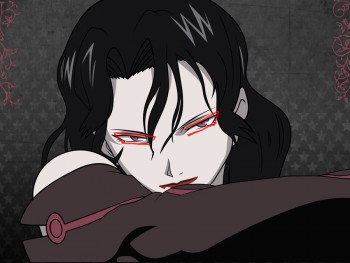

Also i did a red-line over your original piece, it's kind of a messy job i did but it gives you a general idea of how the figure can be improved. I modeled the proportions on a standard Anime Girl measurement.
Spoiler:

Sneakyone wrote...
Antw0n wrote...
inb4 flat-chest faggotsFuck your avatar
IT: No, full figured women are great.
You broke her heart, fag.

rin^2 wrote...
Nice figures here:http://img266.imagevenue.com/loc112/th_886141941_Image300032_122_112lo.JPG
For your Photoshop image, the background is too saturated and dominant and it's overpowering the figure. Maybe you can try toning it down a few notches with a more neutral tone. Right now, it's competing with the main subject for attention.
I ended up deleting it, lol. I didn't work the edges right so the whole image turned out way to blurry. I primarily did it as a digital practice to get used to the Tablet. My lack of confidence in digital shows, i end up using a lot of soft brushes since it's a lot easier to notice mistakes when you use a hard brush. I've been working with the Crimson Daggers to help get my Digi confidence level up.
And yeah the colors are WAY to saturated, i agree. I downloaded a color wheel plug-in for Photoshop so hopefully i can balance my complimentary color themes better.